
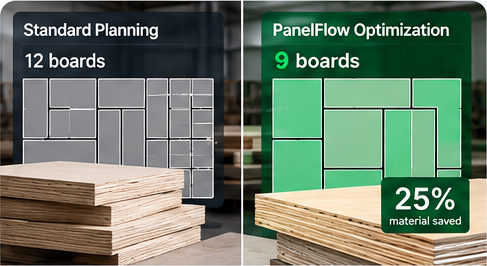
Optimization can sound abstract until you put two numbers next to each other. So we took one ordinary cutlist — a set of wardrobes plus a small kitchen — and ran it two ways: cut by eye, board-by-board, and planned across all sheets before the first cut.
The setup
Same parts, same 18 mm ply, same 8×4 ft boards (₹3,360) and laminate sheets (₹2,000). The only difference is how the parts are placed on the sheets.
Cut by eye
Filling each board by hand, the last part on most sheets leaves a strip too small to use. Utilization lands around 75%, and the offcuts pile up behind the saw.
Optimized
Planning all parts together lets each board's leftover become the home for the next part. Utilization crosses 90%, and the same parts need fewer sheets.
The result, side by side
| By eye | Optimized | Saved | |
|---|---|---|---|
| Board utilization | ~75% | ~92% | +17 pts |
| Plywood boards | 12 | 9 | 3 |
| Laminate sheets | 18 | 12 | 6 |
| Material cost | ₹76,320 | ₹54,240 | ₹22,080 |
Why the gap exists
By-eye cutting makes each decision in isolation, so it can't see that a part on board 7 would have perfectly filled the gap left on board 2. Optimization looks at the whole job at once and places parts where they waste the least — the same reason packing a suitcase all at once beats stuffing items in one by one.
The honest test is your own work: take a finished job's cutlist and see how few boards it should have needed. That gap is repeatable on every similar job from here on.
See the gap on your own cutlist
Send a real cutlist and we'll show you the optimized result against what you use today. Free, no obligation.
Share your cutlist