
If you run a furniture or modular unit, board and laminate are your single biggest material cost — and quietly, your biggest leak. A sheet costs the same whether you use 70% of it or 95% of it. The difference between those two numbers is pure profit walking out as offcuts.
The frustrating part is that most of this waste is invisible. It doesn't show up as a line item; it's spread across dozens of half-used boards stacked behind the saw. This guide breaks down where it hides and how to plan it out — with a worked example you can check against your own last project.
Where the waste actually comes from
When we look at real cutlists, the loss almost always traces back to four things:
- Cutting board-by-board instead of project-wide. When each board is filled by eye, the last part on each sheet leaves an awkward strip that's too small for the next part but too big to ignore.
- Not grouping parts by material and thickness. Parts that could share a sheet get spread across several because they were cut in list order, not the order that packs tightest.
- Ignoring grain and laminate direction until the saw. A part that has to run a certain way can force a fresh sheet if it wasn't planned for up front.
- Rounding "just to be safe." Ordering an extra board or two per job is common — and across a month it's often more than a whole project's worth of material.
A quick worked example
Take a modest modular job — a set of wardrobes and a kitchen — with parts that, cut the usual way, fill 12 plywood boards and 18 laminate sheets. Here's the same cutlist planned to pack parts across sheets before any cutting starts:
| Material | Cut by eye | Planned | Saved |
|---|---|---|---|
| Plywood boards (₹3,360 each) | 12 | 9 | 3 (25%) |
| Laminate sheets (₹2,000 each) | 18 | 12 | 6 (33%) |
| Material cost | ₹76,320 | ₹54,240 | ₹22,080 |
Same design, same parts, same finish — just planned before the first cut. On one job that's ₹22,080 back. Across a month of jobs, it's the kind of number that changes what a quote can afford to be.
Five practical ways to cut the waste
You can start on your very next job:
- Plan the whole project at once, not board-by-board. Lay out every part across all your sheets together so the offcuts from one part become the home for the next.
- Group by material, thickness and finish first. Never let a 6mm part and an 18mm part compete for the same sheet in your head.
- Decide grain and laminate direction on paper, before the saw. Lock it in the plan so it never forces a fresh sheet mid-cut.
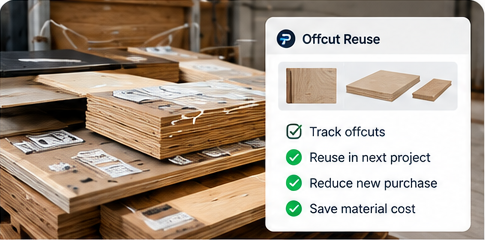
- Keep and label your offcuts. A tidy rack of known offcut sizes is free inventory for small parts on the next job.
- Order to the plan, not to a gut feeling. Once you know the real board and laminate count, the "safety" sheets mostly disappear.
Where cutting optimization comes in
Doing all of the above by hand is possible — it's just slow, and it gets harder the bigger the job. This is exactly what a cutting-optimization system does automatically: it takes your cutlist, nests every part across the fewest sheets possible while respecting grain and thickness, and hands you the exact board and laminate quantity to order. No design changes, no re-drawing — just a tighter plan and a shorter material bill.
The honest test is your own past work. Take a cutlist from a project you've already finished, and see how many boards and laminates it should have needed. The gap is what you can save on the next one just like it.
See how much your own project could save
Send us a cutlist — a new project you're planning or one you've already completed. We'll run it through PanelFlow and send back the optimized board & laminate requirement. Free, no obligation.
Share your cutlist