
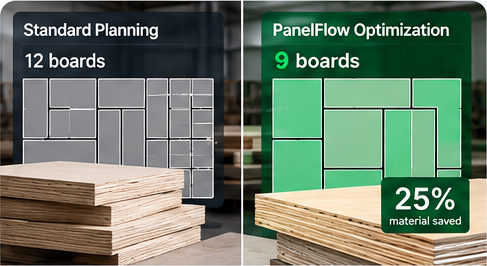
Every sheet of plywood or laminate costs the same whether you turn 70% of it into finished parts or 95%. That share — how much of each board becomes real parts instead of offcut — is your board utilization. It's the quietest lever on your material cost, and most workshops never put a number to it.
What board utilization actually measures
Board utilization is simply the total area of the parts you cut, divided by the total area of the sheets you used to cut them — expressed as a percentage.
If your parts add up to 30 sq.m and you used 40 sq.m of board to cut them, your utilization is 75% — and the other 25% (10 sq.m) left the factory as waste. Push the same parts onto 33 sq.m of board and you're at ~90%, having bought seven fewer square metres of material for the exact same output.
How to calculate it on your own job
- Add up the area of every part: length × width × quantity, for all parts on the cutlist.
- Add up the area of the sheets used: a standard 8×4 ft board is about 2.98 sq.m; multiply by the number of boards you actually consumed.
- Divide parts by sheets and multiply by 100. That's your utilization.
Do it once for your last completed job and you'll have a real baseline — most people are surprised how much lower it is than they'd guessed.
Why a few percent is a big deal
Because utilization decides how many boards a fixed set of parts actually needs. Take a job whose parts total roughly 27 sq.m and see how the board count — and the bill — moves with utilization (boards at ₹3,360 each):
| Utilization | Boards needed | Material cost |
|---|---|---|
| 70% (by eye) | 13 | ₹43,680 |
| 80% | 12 | ₹40,320 |
| 90%+ (optimized) | 10 | ₹33,600 |
Same parts, same design — but the difference between 70% and 90% is 3 boards (₹10,080) on a single job, before you even count laminate. Repeat that across a month of jobs and it's the difference between a tight quote and a comfortable one.
What pulls utilization down — and how to lift it
The usual culprits are cutting board-by-board instead of planning the whole project, mixing thicknesses and finishes on the same sheet, and deciding grain direction only at the saw. The fix is the same in every case: plan all the parts across all the sheets before the first cut, group them by material and thickness, and lock grain direction on paper. (We go deep on this in our guide on reducing plywood & laminate wastage.)
The easy way to know your number
You don't have to do the arithmetic by hand. Send us a cutlist and we'll run it through PanelFlow, calculate the utilization you'd get, and tell you the exact optimized board and laminate count — so you can compare it against what you're using today.
Find out your real board utilization
Send a cutlist from a new or completed project. We'll run it through PanelFlow and show you the utilization and the optimized material count. Free, no obligation.
Share your cutlist